


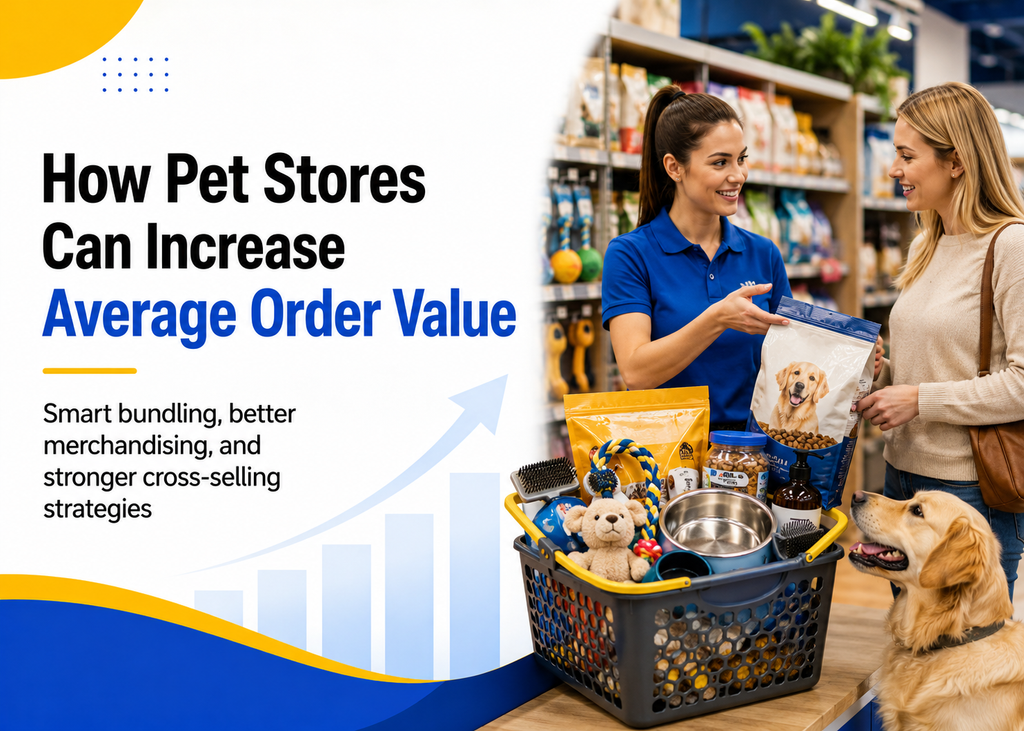
Growing a pet retail business does not always mean finding more customers.
In many cases, one of the fastest ways to improve revenue is to make each customer visit more valuable.
That is where average order value (AOV) becomes important.
For pet stores, increasing average order value means helping customers discover relevant products that genuinely complement what they already need—whether that is food, grooming, hygiene, training, travel, or everyday pet care.
Done well, it improves convenience for the customer while helping the retailer build stronger margins, better category performance, and more value from every transaction.
What Is Average Order Value in Pet Retail?
Average order value shows how much a customer spends, on average, during one transaction.
The basic calculation is simple:
Average Order Value = Total Revenue ÷ Total Number of Transactions
For example, if a pet store generates ₹5,00,000 from 1,000 transactions in a month, its average order value is ₹500.
The number itself is useful, but the real opportunity comes from understanding what influences it.
Retailers can look at AOV by category, store location, customer type, or even time period. This can reveal which areas of the business are already encouraging larger baskets—and which ones are leaving revenue on the table.
1. Bundle Products Around Real Customer Needs
Bundling is one of the most practical ways to increase pet store average order value, but the strongest bundles are not built around random discounts.
They are built around customer needs.
A shopper buying dog food may also need treats, feeding bowls, storage containers, supplements, or dental-care products. Someone purchasing grooming shampoo may also benefit from a brush, wipes, paw-care products, or a towel.
The idea is to make the purchase journey easier.
Instead of asking, “What else can we sell?”, a better question is:
“What else would make this purchase more complete or useful for the pet parent?”
That mindset creates bundles that feel helpful rather than promotional.
Retailers can also build occasion-based combinations around:
- New puppy or kitten essentials
- Grooming routines
- Travel with pets
- Training needs
- Seasonal care
- Feeding and hydration
- Everyday hygiene
These kinds of product groupings can naturally increase basket size while improving the shopping experience.
2. Train Staff to Cross-Sell Without Making It Feel Like Selling
In physical pet retail, staff can have a major influence on transaction value.
A knowledgeable team member who understands the customer’s pet, product choice, and likely needs can make recommendations that feel personal and useful.
For example, instead of saying:
“You should buy this too.”
A better conversation may be:
“If your dog is switching to this food, some customers also find it useful to introduce it gradually. Do you already have enough of the current food at home?”
The difference is small, but important.
Effective pet retail cross-selling is based on context, not pressure.
Staff training should therefore go beyond product features. Team members should understand category relationships, common customer questions, and when an add-on genuinely makes sense.
The goal is not to increase every bill at any cost.
It is to build enough trust that customers feel comfortable accepting relevant recommendations.
3. Improve Merchandising and Product Placement
Customers are more likely to buy complementary products when those products are easy to discover.
That sounds obvious, but many stores still organise shelves around internal categories rather than customer shopping behaviour.
A customer buying food should not have to walk across the store to find feeding accessories. Grooming products, brushes, wipes, and related hygiene items should be visually connected wherever possible.
Think in terms of shopping missions, not only shelves.
Products used together should often be seen together.
Clear category signage, end-cap displays, checkout-area add-ons, and simple “complete the routine” merchandising can all help increase basket size without relying on aggressive promotions.
Good merchandising quietly answers the customer’s next question before they have to ask it.
4. Create Good-Better-Best Product Options
Not every customer wants the cheapest option.
Some shoppers are willing to spend more when the differences between products are easy to understand.
That is why a good-better-best pricing structure can work well in pet retail.
Instead of presenting one option, retailers can offer:
Good: Reliable entry-level choice
Better: Improved features, ingredients, design, or convenience
Best: Premium option with stronger differentiation
This gives customers a useful comparison and helps them make a more informed decision.
The key is to explain the value clearly.
A premium product should not simply cost more. Customers need to understand why it may be better suited to their needs.
When that value is communicated properly, premium tiers can lift average order value while still protecting customer trust.
5. Build Cross-Category Shopping Habits
One of the biggest growth opportunities for many pet stores is increasing the number of categories each customer purchases from.
A customer may initially visit for food but eventually purchase treats, toys, grooming products, hygiene essentials, accessories, or travel products from the same retailer.
That shift matters.
The more relevant categories a customer trusts a store for, the higher their potential lifetime value becomes.
Retailers can encourage this naturally through:
- Category discovery displays
- New-product introductions
- Staff recommendations
- Loyalty programmes
- Educational content
- Product sampling where appropriate
- Seasonal campaigns
The objective is to become a trusted destination for more of the customer’s pet-care needs, rather than a place they visit for only one product.
6. Use Loyalty to Increase Customer Value Over Time
Average order value should never be viewed in isolation from customer loyalty.
Pet retail is built around repeat purchasing.
Food, treats, grooming products, litter, hygiene products, and many other categories create recurring buying behaviour.
A customer who trusts the store is far more likely to explore new products, consider premium alternatives, and accept staff recommendations.
That is why service quality, consistent stock availability, product knowledge, and personalised communication all matter.
Loyalty programmes can support this by rewarding repeat purchases, encouraging category exploration, or offering benefits based on customer behaviour.
But the programme should feel genuinely valuable.
A complicated points system will rarely compensate for a poor customer experience.
7. Measure What Actually Improves Profitability
Increasing AOV is useful, but a higher bill does not automatically mean a better business.
Retailers should look at average order value alongside other metrics, including:
- Gross margin
- Conversion rate
- Product attachment rate
- Units per transaction
- Repeat purchase rate
- Category penetration
- Customer lifetime value
For example, a heavily discounted bundle may increase the transaction value but reduce margin.
Likewise, pushing unnecessary add-ons may improve one transaction while damaging long-term trust.
The best pet retail strategies improve both customer value and commercial performance.
Testing is therefore important.
Try different bundles, shelf placements, product combinations, staff scripts, or premium tiers. Measure the results and keep what genuinely works.
Over time, small improvements across hundreds or thousands of transactions can create a meaningful impact on revenue.
8. Focus on Customer Value, Not Just Bigger Bills
The strongest way to increase pet store sales is not to convince customers to buy more for the sake of it.
It is to make the store more useful.
When customers can discover better product combinations, compare options clearly, receive knowledgeable advice, and complete more of their pet-care needs in one place, basket size often grows naturally.
That is the difference between transactional selling and strong retailing.
One tries to increase today’s bill.
The other builds a customer relationship that can grow for years.
For pet retailers, that long-term approach can improve average order value, repeat purchase behaviour, category performance, and overall profitability at the same time.
Discover New Products and Pet Retail Opportunities at IIPTF
Retailers looking to strengthen their product mix should regularly explore new categories, emerging brands, supplier relationships, and changing customer preferences.
IIPTF brings together pet retailers, brands, manufacturers, distributors, suppliers, and industry professionals, creating opportunities to discover new products, understand category trends, and build partnerships that can support long-term business growth.
For retailers planning their next stage of expansion, stronger assortment decisions and better supplier relationships can be just as important as increasing store traffic.
Frequently Asked Questions
How can pet stores increase average order value?
Pet stores can increase average order value through relevant product bundling, cross-selling, smarter merchandising, premium product tiers, loyalty programmes, and better staff recommendations. The most effective strategies help customers complete a genuine pet-care need rather than simply pushing additional products.
How is average order value calculated in a pet store?
Average order value is calculated by dividing total sales revenue by the total number of transactions during a selected period.
AOV = Total Revenue ÷ Number of Transactions
Tracking the number monthly can help retailers understand whether merchandising, product mix, promotions, and cross-selling strategies are improving basket value.
What is the difference between cross-selling and upselling in pet retail?
Cross-selling recommends a complementary product, such as suggesting treats or a feeding bowl when a customer purchases pet food.
Upselling encourages the customer to consider a higher-value version of the product they are already buying, such as moving from a standard option to a premium alternative.
Both can increase transaction value when the recommendation is relevant to the customer.
Can product bundling increase pet store profitability?
Yes, but profitability depends on how the bundle is structured. Bundles can improve basket size and category discovery, but retailers should monitor margins rather than relying heavily on discounts. The best bundles provide convenience or additional value while maintaining healthy profitability.
Do staff recommendations really improve pet store sales?
Yes. Well-trained staff can help customers discover relevant products, compare options, and make more confident purchasing decisions. Recommendations tend to work best when they are based on the pet’s needs and the customer’s existing purchase rather than aggressive selling.
What metrics should pet retailers track besides average order value?
Pet retailers should also monitor gross margin, units per transaction, conversion rate, product attachment rate, repeat purchase rate, category penetration, and customer lifetime value. Together, these metrics provide a clearer picture of whether higher transaction values are translating into sustainable business growth.
