


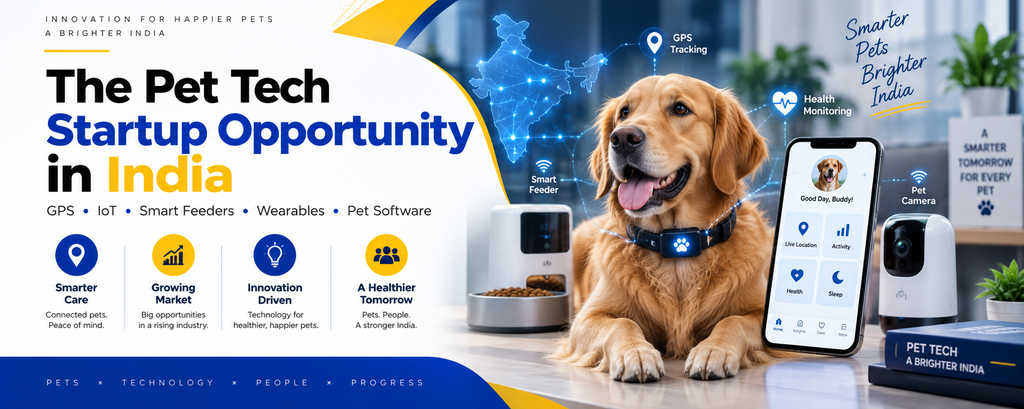
A GPS collar that tells you where your dog is.
A feeder that serves dinner when you’re stuck in traffic.
A health wearable that notices changes in activity before the pet parent does.
A single app that stores vaccination records, appointments and everyday care information.
Pet care is becoming increasingly connected—and that creates an interesting opportunity for pet tech startups in India.
But the opportunity is bigger than putting Wi-Fi into another pet product.
The businesses most likely to build lasting value will use technology to solve a recurring problem for pet parents, veterinarians, retailers or other pet-care professionals.
That distinction matters.
Because in 2026, a “smart” product is not automatically a useful product.
Why Pet Technology Is Becoming More Relevant in India
Pet technology is developing inside a much larger shift in India’s pet economy. Founders evaluating connected devices, software or digital health can also study the broader India pet industry investment landscape to understand which business models are attracting serious capital and where investors see scalable opportunity
India’s wider pet-care economy is expanding.
Grand View Research estimates India’s pet-care market at approximately $2.52 billion in 2026 and forecasts it to reach about $4.32 billion by 2033, representing an estimated 8% CAGR between 2026 and 2033.
That figure represents the broader pet-care market—not pet technology alone.
There is currently no single authoritative public estimate that cleanly measures India’s standalone pet-tech market.
Still, the underlying conditions are becoming more favorable for technology-led pet businesses:
- Growing professionalisation of pet services
- Greater use of ecommerce and mobile apps
- Expansion of veterinary healthcare
- Increasing demand for convenience
- Better smartphone connectivity
- Rising interest in premium pet care
- More organised retailers and service providers
- Growing comfort with connected-home products
Technology therefore has room to become an enabling layer across the wider pet ecosystem.
What Exactly Counts as Pet Tech?
Pet technology is much broader than GPS collars.
It can include both consumer hardware and business software.
Consumer pet technology
Examples include:
- GPS collars and trackers
- Activity monitors
- Smart feeders
- Connected water fountains
- Pet cameras
- Smart doors
- Automatic litter systems
- Environmental monitors
- Connected toys
Pet healthcare technology
This can include:
- Digital health records
- Appointment platforms
- Remote triage tools
- Activity and behavior monitoring
- Medication reminders
- Clinic-management software
- Diagnostic-support technology
B2B pet technology
Technology can also help pet businesses operate more efficiently through:
- CRM systems
- Appointment management
- Inventory tools
- Customer communication
- Loyalty systems
- Billing software
- Retail analytics
- Grooming and boarding management
- Veterinary workflow tools
For founders, that creates an important choice:
Do you want to manufacture a smart pet product—or build infrastructure for the businesses already serving pet parents?
The second option can sometimes require much less hardware risk.
Start With the Problem, Not the Gadget
This may be the most important rule for anyone building a pet-tech company.
Do not begin with:
“What smart device can we manufacture?”
Begin with:
“What recurring problem is painful enough that a pet parent or pet business will pay to solve it?”
Examples include:
“My dog sometimes escapes from our property.”
“I reach home late and feeding schedules become inconsistent.”
“I have no single place for my pet’s medical records.”
“My veterinary clinic loses time to manual appointment management.”
“I want to understand whether my pet’s daily activity has changed significantly.”
“I run a grooming business and struggle with bookings, reminders and repeat customers.”
Technology becomes valuable when it removes that friction.
Adding Bluetooth, AI or a mobile app does not create product-market fit by itself.
1. GPS Trackers and Smart Collars
Location tracking remains one of the clearest connected-device use cases because the customer problem is simple to understand:
Where is my pet?
A useful GPS pet tracker might combine:
- Location tracking
- Geofencing
- Escape alerts
- Activity data
- Mobile notifications
- Battery monitoring
For an Indian product, however, the challenge is not simply adding GPS.
Founders need to think about:
Battery life: A tracker that needs constant charging quickly becomes frustrating.
Weight and comfort: Small dogs and cats need compact hardware.
Connectivity: Cellular coverage and device-network compatibility matter.
Weather resistance: Products may face rain, dust, heat and humidity.
Location accuracy: Dense urban environments can behave differently from open spaces.
Recurring connectivity cost: Cellular tracking may involve ongoing network expense.
The stronger business model may therefore combine the device with an optional service layer—but only if the subscription delivers obvious ongoing value.
2. Smart Feeders
Smart feeders address another recurring problem:
consistent feeding when the pet parent is not physically present.
Potential features include:
- Scheduled portions
- Remote feeding
- Portion control
- Feeding-history logs
- Low-food alerts
- Backup power
- Multiple-pet recognition
- Camera integration
But reliability matters more than novelty.
If a feeder loses internet connectivity, does the feeding schedule continue locally?
If the power fails, is there a backup?
Can the mechanism handle different kibble sizes?
Can a curious dog break into the food compartment?
How easy is it to clean?
These practical questions will determine whether the device becomes part of the household—or another abandoned gadget.
3. Connected Water Fountains
Smart water fountains can combine water circulation with features such as:
- Filtration
- Water-level monitoring
- Filter-replacement reminders
- Pump alerts
- Consumption tracking
- App notifications
The more interesting long-term opportunity may be behavioral data rather than simply remote control.
Changes in drinking patterns can be useful information for pet parents.
But startups should be careful about converting an observation into a medical claim.
A device can report:
“Water consumption has changed.”
That does not automatically mean it can diagnose disease.
Any health-related interpretation needs appropriate evidence and veterinary involvement.
4. Pet Cameras and Remote Monitoring
Pet cameras are easy for consumers to understand.
Common features include:
- Live video
- Motion alerts
- Two-way audio
- Night vision
- Recorded clips
- Treat dispensing
- Cloud storage
From a startup perspective, the challenge is differentiation.
General-purpose home cameras already perform many of these functions.
So a pet-specific camera needs to provide additional value.
That may come from:
- Pet-specific motion detection
- Multi-pet recognition
- Activity summaries
- Bark detection
- Feeding integration
- Behavioral timelines
- Connections with other pet devices
Recurring cloud-storage revenue may strengthen the business model—but only if enough customers see continued value after purchasing the hardware.
5. Health and Activity Wearables
Pet wearables become much more interesting when they move beyond counting steps.
Potential measurements can include:
- Activity
- Rest patterns
- Location
- Behavior changes
- Certain physiological signals, depending on the device
The opportunity is compelling because pets cannot verbally explain when something feels different.
Technology can help owners observe trends.
But health technology needs unusually careful positioning.
A consumer wearable should not claim to diagnose arthritis, heart disease or another condition simply because activity changes.
A responsible product might instead say:
“Your dog’s activity has been lower than its recent baseline.”
That information can prompt a pet parent to observe the animal more closely or speak to a veterinarian.
The distinction between monitoring and diagnosis is critical.
6. Pet Management Apps
Not every pet-tech startup needs hardware.
A well-designed software product can solve everyday problems without manufacturing a single device.
Pet management apps can potentially centralize:
- Vaccination records
- Medication reminders
- Vet appointments
- Grooming schedules
- Insurance documents
- Nutrition notes
- Pet-service bookings
- Household care instructions
The strongest apps will probably not succeed because they offer the most features.
They will succeed because they become part of a recurring workflow.
An app that a pet parent opens twice a year is difficult to monetize.
A product used weekly—or a B2B platform embedded into daily business operations—can create much stronger retention.
7. Technology for Veterinary Clinics and Pet Businesses
One of the less glamorous but potentially more defensible opportunities in Indian pet tech is software for the industry itself.
A veterinary clinic may need:
- Appointment management
- Digital records
- Customer reminders
- Billing
- Follow-up communication
- Inventory
- Multi-location reporting
A grooming salon may need:
- Online booking
- Customer history
- Automated reminders
- Repeat-booking prompts
- Staff scheduling
- Payment tracking
A pet retailer may benefit from:
- CRM
- Loyalty
- Inventory analytics
- Subscription management
- Customer segmentation
B2B software can create recurring revenue without the tooling, inventory and warranty risk of physical hardware.
That makes it worth serious consideration.
India-Specific Product Design Can Become an Advantage
Imported pet technology is not automatically unsuitable for India.
But copying a product designed for another market without considering local conditions can create problems.
Indian startups should think about:
- Heat and humidity
- Dust exposure
- Power reliability
- Cellular/network conditions
- Smaller living spaces
- Multi-generational households
- Local pricing expectations
- Customer support
- Regional-language onboarding
- Replacement-part availability
This creates an opportunity for localisation.
A feeder with local offline scheduling and battery backup may solve a more relevant problem than one with twenty cloud features.
A collar designed around Indian network conditions and weather may outperform a premium imported device in everyday reliability.
Localisation should improve the product—not simply reduce the price.
Privacy and Cybersecurity Are Now Product Features
Connected pet devices often collect far more than pet data.
A GPS collar can reveal location.
A camera can capture video from inside someone’s home.
An app may hold:
- Names
- Phone numbers
- Addresses
- Payment details
- Location history
- Account credentials
- Household routines
That makes privacy a product-design issue.
India’s Digital Personal Data Protection Rules were notified in November 2025, with phased implementation of the DPDP framework. Startups processing digital personal data should build consent, purpose limitation, security and data-handling practices into their architecture rather than bolting them on later.
India’s Telecommunication Engineering Centre has also published an updated Code of Practice for Securing Consumer IoT, reflecting growing attention to security in connected products.
For a pet-tech founder, practical questions include:
- How is user data encrypted?
- Where is video stored?
- Can users delete their accounts and associated data?
- Are default passwords secure?
- How are firmware updates delivered?
- What happens if the company stops supporting the device?
- Does the product collect more information than it actually needs?
Trust can become a competitive advantage.
What Regulations Can Apply to Pet-Tech Hardware in India?
There is no single “pet tech certification.”
Compliance depends on what the product actually contains and does.
BIS requirements
The Bureau of Indian Standards operates compulsory-registration and certification frameworks covering specified electronics and components.
For example, certain portable secondary lithium batteries fall within BIS’s compulsory-registration framework.
But a founder should not assume that every connected pet device follows exactly the same compliance route.
Evaluate the:
- Finished product
- Battery
- Charger/power adapter
- Electrical components
- Applicable product category
individually.
Wireless / WPC requirements
Wireless devices using technologies such as Wi-Fi, Bluetooth or other RF functionality may fall within the Wireless Planning & Coordination Wing’s Equipment Type Approval framework where applicable.
DoT states that ETA is required for qualifying wireless communication devices operating in de-licensed frequency bands and permits self-declaration for many commercial finished products.
Cellular products
A cellular GPS tracker can introduce additional telecom, module, SIM and network considerations.
Do not leave compliance until the final production run.
Regulatory mapping should happen during product architecture.
A module choice made in month one can determine what testing you face later.
Domestic Manufacturing or Import?
There is no universal answer.
Importing can make sense when:
- You want to test demand quickly
- Initial volumes are small
- Tooling investment would be premature
- A proven OEM design already exists
Local manufacturing or assembly can make sense when:
- Volume becomes meaningful
- You need product customization
- Faster iteration matters
- Supply-chain control becomes important
- After-sales support requires local parts
- Import economics become unattractive
A hybrid model can also work
Some businesses may source specialized electronics internationally while carrying out:
- Enclosure production
- Final assembly
- Testing
- Packaging
- Quality control
in India.
The right question is not:
“Is Made in India better?”
It is:
“Which supply-chain structure gives us the right balance of quality, cost, flexibility and reliability?”
Don’t Build the Financial Model Around Hardware Margin Alone
Hardware can look attractive on a spreadsheet until the real costs arrive.
Your unit economics should account for:
- Manufacturing
- Freight
- Duties
- Warehousing
- Payment fees
- Returns
- Warranty replacements
- Customer support
- App development
- Cloud infrastructure
- SIM/data costs
- Firmware maintenance
- Retailer/distributor margins
- Marketing
A device sold for ₹8,000 is not an ₹8,000-margin business.
That sounds obvious.
Yet hardware startups often underestimate what happens after the sale.
When Does a Subscription Model Make Sense?
Subscriptions are attractive because recurring revenue can improve predictability.
But customers do not subscribe because investors like recurring revenue.
They subscribe because they receive recurring value.
Possible subscription features include:
- Cellular connectivity
- Cloud video storage
- Advanced health reports
- Extended data history
- Multi-device management
- Premium veterinary access
- Insurance-linked services
Ask one uncomfortable question:
If the subscription disappeared tomorrow, would the customer genuinely miss it?
If the answer is no, retention will eventually expose the problem.
What Metrics Should Pet-Tech Founders Track?
If it’s hardware businesses:
- Gross margin per device
- Return rate
- Warranty claim rate
- Customer support cost
- Activation rate
- Device retention
- Manufacturing defect rate
For connected products:
- Monthly active devices
- App engagement
- Subscription attach rate
- Subscription churn
- Cloud cost per active user
- Connectivity cost per device
For B2B software:
- Monthly recurring revenue
- Customer acquisition cost
- Retention
- Revenue per account
- Feature adoption
- Churn
- Payback period
Downloads are not enough.
Devices shipped are not enough.
A strong pet-tech company needs evidence that the product keeps delivering value after purchase.
Go-to-Market: Show the Product Solving the Problem
Pet technology often requires education.
That makes demonstration especially powerful.
Video can show:
- A GPS escape alert arriving on a phone
- A feeder working during a late office evening
- A clinic using digital records
- A grooming salon managing appointments
- A wearable displaying changes in activity
The marketing should begin with the problem.
Not:
“AI-powered IoT smart pet ecosystem.”
Instead:
“Know when your dog leaves the safe zone.”
Clear beats technical.
D2C and B2B Should Work Together
Direct-to-consumer channels are useful because they provide:
- Fast customer feedback
- Product data
- Brand control
- Higher potential gross margin
- Testing opportunities
But physical pet-industry distribution can create something digital ads cannot:
trust at the point of recommendation.
Depending on the product, potential partners include:
- Pet stores
- Veterinary clinics
- Groomers
- Boarding businesses
- Trainers
- Distributors
- Ecommerce marketplaces
For health-related technology, veterinary credibility can be especially valuable—but recommendations should never be manufactured through unsupported medical claims.
What Role Does IIPTF Play in Pet Technology?
Pet technology has moved visibly into India’s broader industry conversation.
The 16th India International Pet Trade Fair, held on 29–30 August 2026 at Bharat Mandapam in New Delhi, included a dedicated session titled “Pet Technology Playbook for the Industry,” featuring Happy Pet founder Anil Reddy.
The broader IIPTF platform brings together manufacturers, retailers, distributors, importers, service providers, veterinarians and other pet-industry professionals.
For pet-tech founders, that type of B2B ecosystem matters because successful hardware or software does not scale on product development alone.
You also need:
- Distribution
- Industry feedback
- Retail relationships
- Veterinary partnerships
- Manufacturing contacts
- Service infrastructure
- Market visibility
The original product may begin in a lab.
The business gets built in the market.
Where Are the Strongest Pet-Tech Opportunities?
Rather than ranking categories as universally “high” or “low” demand without reliable India-specific adoption data, evaluate each opportunity by the problem it solves and the economics it can support.
| Category | Core opportunity | Biggest challenge |
|---|---|---|
| GPS Trackers | Location safety + recurring connectivity | Battery, network reliability, subscription value |
| Smart Feeders | Convenience + feeding consistency | Mechanical reliability, cleaning, power backup |
| Health Wearables | Longitudinal activity/behavior data | Accuracy, interpretation, medical-claim boundaries |
| Pet Cameras | Remote monitoring | Differentiation from ordinary home cameras |
| Pet Apps | Records, reminders and service coordination | User retention |
| B2B Pet Software | Operational efficiency + recurring SaaS | Sales cycles and workflow integration |
| Connected Water/Feeding Devices | Routine behavior data | Hardware reliability and real usefulness |
A Practical Roadmap for Launching a Pet-Tech Startup in India
Step 1: Choose One Pain Point
Do not start with a feature list.
Identify a repeated, measurable problem.
Step 2: Interview Real Users
Speak with pet parents, retailers, veterinarians, groomers or whichever group will use the product.
Watch what they actually do.
Step 3: Validate Willingness to Pay
Interest is not demand.
Ask customers to preorder, join a paid pilot or commit commercially where appropriate.
Step 4: Build the Simplest Useful Product
Avoid spending eighteen months building features nobody has requested.
Step 5: Map Compliance Early
Identify wireless, battery, electrical, privacy and other regulatory requirements before tooling and mass production.
Step 6: Test in Real Indian Conditions
Heat.
Humidity.
Weak connectivity.
Power interruptions.
Multiple pets.
Everyday handling.
Real households reveal problems labs miss.
Step 7: Measure Retention
A successful product should still matter three months after the excitement of unboxing has disappeared.
Step 8: Scale Distribution Only After Product Fit
D2C marketing can generate early orders.
B2B relationships can then expand reach once reliability and customer demand have been proven.
Frequently Asked Questions
Is pet tech a growing opportunity in India?
India’s broader pet-care and pet-services markets are growing, while connected devices, digital health, pet-management software and B2B technology are becoming more visible across the industry. There is not yet one reliable standalone public figure for the size or CAGR of India’s pet-tech market, so founders should be cautious with exaggerated market-size claims.
What are the best pet-tech startup ideas in India?
Promising areas include GPS trackers, smart feeders, activity wearables, pet-business software, digital medical records, clinic-management tools, connected feeding/water devices and pet-service platforms. The strongest opportunity depends on the customer problem and business economics rather than the technology alone.
Do pet-tech devices need BIS certification?
It depends on the exact product and components. Certain electronics, batteries and power products are subject to BIS requirements, but founders should identify the applicable standards for their specific device rather than assume one rule covers all pet-tech hardware.
Do Bluetooth and Wi-Fi pet devices need approval in India?
Wireless products can fall under India’s WPC/ETA framework depending on their radio functionality and frequency bands. Regulatory review should take place during product design, particularly for imported RF modules or finished wireless devices.
Are GPS pet trackers a good business opportunity?
They solve a clear safety problem, but the economics depend on hardware cost, connectivity, battery life, device reliability, subscription retention and customer-support requirements.
Should a pet-tech startup manufacture in India or import?
Early-stage startups may use OEM/import models to validate demand, while local manufacturing or assembly can become attractive as volumes, customization and supply-chain requirements increase. A hybrid strategy is also possible.
Can pet-tech startups generate subscription revenue?
Yes, when customers receive ongoing value such as cellular connectivity, cloud storage, advanced analytics or recurring services. Adding a monthly charge without a meaningful continuing benefit is unlikely to produce strong retention.
How much money is required to launch a pet-tech startup?
There is no credible universal number. A software MVP, imported-device pilot and custom hardware company can require radically different levels of capital. Founders should budget from their actual product architecture, certification path, minimum order quantities, tooling, software, inventory and support model.
Final Outlook: India’s Pet-Tech Opportunity Is Not About More Gadgets
There is a temptation whenever a sector grows to connect everything to an app.
That is not the opportunity.
The real opportunity is finding moments in pet care where technology makes something meaningfully:
safer, easier, more reliable, more measurable or more efficient.
A GPS tracker that reliably helps recover a missing pet has value.
A feeder that keeps working when Wi-Fi goes down has value.
Software that gives a veterinarian back an hour of administrative time has value.
A wearable that presents useful behavior trends without pretending to diagnose disease has value.
That is where India’s strongest pet-tech businesses are likely to emerge.
Not from adding technology for its own sake.
From making pet care work better.
