


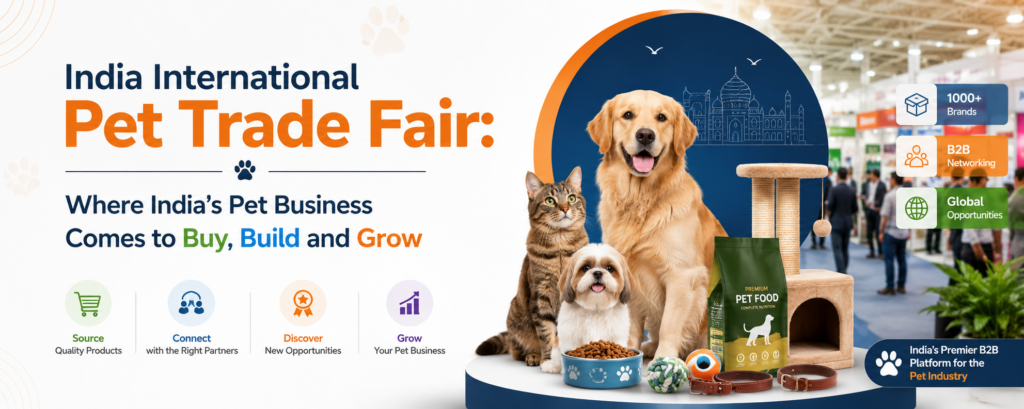
The trade floor India’s pet industry needed
India’s pet economy is no longer waiting to be discovered. It is already moving through retail shelves, veterinary clinics, grooming studios, D2C brands, distributor warehouses, aquatics stores, boarding centres and neighbourhood pet shops across the country. What many businesses still need is a place where that scattered energy becomes visible, organised and commercially useful. That place is the India International Pet Trade Fair, better known as IIPTF.
IIPTF is not built like a casual pet day out. It is built like a market meeting. Brands come with catalogues, samples and launch plans. Distributors come with regional demand. Retailers come with category gaps. Veterinarians, groomers, trainers and boarding professionals come looking for tools, products, partnerships and practical knowledge. New entrants come to understand whether the pet care industry is only attractive from the outside or genuinely viable as a business.
The answer, increasingly, is that India’s pet market is becoming too important to watch from a distance. Official IIPTF communication positions the event as the Indian subcontinent’s premier B2B pet exhibition, with the 16th edition scheduled for 29 and 30 August 2026 at Bharat Mandapam, New Delhi. The organisers also describe the 2026 show as geared to host 300+ exhibitors from 18+ countries. That makes IIPTF not just a calendar listing but a trade gateway for brands that want to sell into India and Indian businesses that want to source, scale and compete with confidence.
What makes IIPTF different from a regular pet exhibition?
Many pet events are designed around experience. IIPTF is designed around business intent. That single difference changes everything. A consumer event may create footfall, photographs and awareness. A serious B2B trade fair creates supplier meetings, distributor conversations, retail leads, category comparisons, franchise discussions, import-export possibilities and professional learning.
The uploaded brief describes IIPTF as a purely B2B exhibition that facilitates pet retailers, distributors, veterinarians, groomers, trainers and dog boarding centres to source new products and reconnect with existing suppliers. It also notes that the last edition witnessed business visitors from more than 223 cities across India. That detail is important because the future of the Indian pet industry will not be written only in metro cities. Demand is moving outward. Organised pet care is entering smaller markets. Retailers outside the top metros need access to reliable brands, and brands need regional partners who understand those markets.
IIPTF works because it compresses months of business development into two focused days. Instead of calling suppliers one by one, a retailer can walk categories, compare options and read the market in real time. Instead of guessing which distributors are active, a brand can meet them face to face. Instead of building a pet business from internet research alone, a new entrepreneur can stand inside the ecosystem and see how it actually works.
The pet business case: why the timing matters now
Pet care in India is moving from emotional ownership to structured spending. Families are buying better food, looking for reliable grooming, seeking preventive healthcare, choosing cat litter and hygiene products more carefully, and exploring services such as boarding, daycare and training. Market estimates vary, but the direction is consistent: India’s pet care category is expanding and professionalising. Wazir Advisors projects India’s pet care market to grow from roughly INR 10,000-10,500 crore in 2025 to INR 25,000-26,000 crore by 2030. StrategyHelix separately projects the Indian pet care market to expand from USD 1,012.8 million in 2025 to USD 1,522.3 million by 2030.
For a brand, this means the market is not simply getting bigger. It is getting more layered. The same pet parent may buy economy food for one use case, premium treats for another, grooming services before travel, veterinary supplements after consultation and accessories through online or offline channels. That creates space for specialised brands, private labels, professional service providers and regional distributors.
For retailers, the question is no longer whether pet products will sell. The sharper question is which categories deserve shelf space, which suppliers can maintain consistency, which products carry repeat purchase potential, and which brands can support education at the store level. IIPTF helps answer those questions in one environment.
Who should attend IIPTF?
IIPTF is most useful for people who have a commercial role in the pet industry or plan to build one. Pet product manufacturers can use the show to test market response, launch products and meet buyers. Distributors can identify brands that fit their region and margin structure. Retailers can compare product quality, packaging, pricing and trade support. Veterinarians can discover nutrition, wellness and healthcare products relevant to clinics. Groomers can evaluate tools, shampoos, tables, dryers and education-led offerings. Trainers and boarding centres can find service partnerships and retail add-ons.
The event is also valuable for aquarium businesses, bird product sellers, kennel operators, NGOs, institutions and media connected with the animal care ecosystem. The co-located Aquagic platform gives the aquarium trade added visibility, covering aquaria, filters, lighting, fish feed, ornamental fish, plants and related products.
One of the most underrated audiences is the new entrepreneur. The brief states that at least 10% of total visitors each year come to understand the industry and explore starting their own pet care venture. That is a powerful role for a trade fair. IIPTF does not only serve existing businesses. It also lowers the knowledge barrier for new entrants, helping expand the organised pet care ecosystem.
What pet businesses can source at the Pet fair
A strong trade fair becomes useful when visitors can map the market category by category. IIPTF covers the practical buying universe of pet care: dog food, cat food, treats, supplements, grooming products, hygiene solutions, cat litter, toys, collars, leashes, beds, apparel, pharma, veterinary products, aquatics supplies, bird feed, cages, seeds, treats and accessories.
For a retailer, this breadth helps answer a simple but difficult question: what should my next shelf look like? For a distributor, it helps identify what is missing in the current portfolio. For a service provider, it opens up cross-sell opportunities. A grooming studio can retail shampoos and brushes. A veterinary clinic can stock recommended nutrition and supplements. A boarding centre can sell hygiene products or toys. A trainer can collaborate with food, accessory or behavioural enrichment brands.
The value of IIPTF is not only in seeing products. It is in seeing how categories sit next to each other, where margins may exist, where consumer education is needed and which suppliers appear ready for long-term trade relationships.
Knowledge is the hidden ROI
Trade shows often focus on booths, but the most valuable return sometimes comes from conversations and learning. The brief notes that IIPTF has moved beyond exhibition and now hosts Knowledge Seminars on training, grooming and social media for pet brands, along with an international dog grooming competition and a symposium.
That matters because the Indian pet business still has education gaps. Many pet parents are upgrading, but they need guidance. Many store owners want to premiumise, but they need staff training and brand support. Many groomers want to charge better rates, but they need stronger technique, hygiene standards and business positioning. Many brands want attention online, but they need trust, not noise.
Knowledge sessions, grooming workshops, competitions and industry dialogues help raise the professional floor. They bring practical intelligence into the room: what customers ask, what retailers struggle with, what products need explanation, what trends are worth watching and what business practices need improvement.
Why pet brands should exhibit, not just visit
For a pet brand, attending IIPTF is useful. Exhibiting can be far more strategic. A booth gives the brand a physical identity in a market where trust matters. Buyers can touch packaging, compare SKUs, understand product stories and ask direct questions about pricing, margins, minimum order quantities, distribution support and marketing material.
The best exhibitors do not treat the booth as decoration. They treat it as a sales room, training room and market research lab. They know which products to demonstrate, which buyers to prioritise, which objections to capture and which follow-up system to run after the event.
A strong booth should answer five buyer questions quickly:
What problem does this product solve?
Who is it for?
What makes it commercially attractive?
How will the brand support sell-through?
Why should a retailer or distributor choose it now?
Brands that prepare these answers before IIPTF are more likely to convert conversations into opportunities. If you want to exhibit at IIPTF 2026, please register here.
How visitors can get more from IIPTF
Visitors should not walk into IIPTF casually. A distributor should arrive with a portfolio gap list. A retailer should know which categories need replacement, expansion or premium options. A groomer should list the tools and consumables that affect daily service quality. A new entrepreneur should prepare questions around investment, supply, training, margins, inventory and customer acquisition.
The smartest way to attend is to split the day into three tracks. First, walk the full floor to understand the market. Second, shortlist booths that match your business goal. Third, return for deeper conversations with decision-makers. Carry business cards, note supplier details, collect catalogues and photograph booth information where allowed. After the event, follow up within a week while conversations are still fresh.
IIPTF can create leads, but the real business happens when visitors turn those leads into disciplined follow-up.
Conclusion: IIPTF is where the pet trade becomes visible
India’s pet industry is growing, but growth alone does not build a mature market. Markets mature when businesses meet, standards rise, buyers compare, suppliers improve, professionals learn and new entrepreneurs enter with better information. That is the role IIPTF plays.
It brings India’s pet trade into one room and makes the opportunity visible. For brands, it is a route to distribution. For retailers, it is a sourcing platform. For service providers, it is a professional upgrade. For entrepreneurs, it is a practical introduction to a promising industry.
The best way to describe IIPTF is simple: it is where India’s pet business comes to buy, build and grow.
