

India’s pet industry is becoming more sophisticated. Pet parents are spending more thoughtfully on nutrition, healthcare, grooming, diagnostics and long-term wellbeing—and that is creating room for financial products designed around the realities of pet ownership.
For entrepreneurs, veterinary businesses, pet retailers and insurance professionals, this creates an interesting question: how can you start a pet insurance business in India without necessarily becoming an insurance company yourself?
The answer depends on the role you want to play.
Some businesses may participate through insurance distribution. Others may build partnerships with licensed insurers or intermediaries, integrate insurance into veterinary or retail journeys, or develop technology that makes discovery, purchase and servicing easier.
But pet insurance is still insurance. That means the opportunity must be approached with both commercial ambition and regulatory discipline.
Why Pet Insurance Is Becoming an Interesting Business Opportunity in India
India’s pet-care ecosystem is expanding beyond food and accessories, creating new opportunities across veterinary care, services, technology, insurance and retail. Businesses exploring this space can also look at the wider Indian pet industry ecosystem to understand where demand and partnerships are developing.
Pet ownership in India has moved well beyond basic food and accessories.
Today’s pet parents increasingly look for better veterinary treatment, diagnostics, specialist care, preventive services and premium products. As the financial commitment involved in caring for an animal increases, protection against unexpected veterinary expenses becomes more relevant.
The market is also beginning to offer greater product choice.
HDFC ERGO currently markets its Paws n Claws pet insurance for dogs and cats, including customizable coverage options. Bajaj Allianz offers pet insurance products with covers that can include surgery, hospitalization, OPD and other optional protections depending on the product selected. Digit also has an IRDAI-filed pet insurance product with multiple coverage sections subject to the policy schedule and terms.
For a new business, this is important.
The opportunity is not simply to create “another insurance policy.” It may be to improve distribution, education, customer experience, product discovery, technology integration or access at the moment when pet parents are most likely to understand the value of protection.
First Decide What Role You Want to Play
Before building a website, hiring a sales team or approaching insurers, determine where your business should sit in the insurance value chain.
This is one of the most important strategic decisions when trying to start a pet insurance business in India.
A pet retailer with thousands of existing customers has a very different advantage from an insurance professional with regulatory expertise. A veterinary group may have trusted relationships at the point of care, while an insurtech company may be strongest at technology, digital onboarding or customer servicing.
Instead of asking:
“How do we launch our own pet insurance?”
Start with:
“What part of the pet insurance journey are we uniquely positioned to improve?”
That answer should influence the business model you choose.
1. Individual Insurance Agent Model
For an individual entering the insurance sector, becoming an appropriately appointed insurance agent may provide a relatively straightforward route into distribution.
An agent represents an insurer and solicits eligible insurance products in accordance with the applicable regulatory framework and insurer requirements.
This model may suit:
- Insurance professionals entering the pet segment
- Pet-industry consultants seeking a regulated distribution route
- Individuals with strong pet-parent networks
- Professionals who want to begin without building a full technology platform
The commercial advantage is simplicity compared with creating a much larger distribution organisation.
The limitation is that your offering and operating framework will depend heavily on the insurer you represent.
2. Corporate Agent Model
An established company may consider operating within India’s corporate-agent framework where appropriate.
This can be more relevant for businesses that already have a meaningful customer base, such as veterinary groups, pet-service companies or larger pet businesses looking to make insurance part of a broader customer proposition.
IRDAI maintains a regulatory framework specifically for corporate agents, separate from individual agents and insurance brokers. Businesses should determine which permitted structure fits their activities before soliciting or selling insurance.
The important point is that having pet customers does not by itself authorize a company to sell insurance.
The regulatory structure needs to come first.
3. Insurance Broker Model
A broker model may be more appropriate for businesses seeking to provide customers with access to products from multiple insurers, subject to the permissions and requirements applicable to the brokerage.
This model can potentially create a broader comparison proposition for customers, but it also involves a significantly more serious compliance and operational commitment.
IRDAI regulates insurance brokers under a distinct regulatory framework.
For entrepreneurs, that makes the decision strategic:
Do you need the capabilities of a broker, or would a partnership with an existing licensed broker achieve the same commercial objective more efficiently?
Starting with the customer problem—not the most complicated licence—is often the better business decision.
4. Technology and Insurtech Partnership Model
Not every attractive opportunity in pet insurance sits in underwriting or direct selling.
Technology companies can potentially create value around:
- Quote journeys
- Customer onboarding
- Policy administration
- Claims communication
- Veterinary integrations
- Renewal engagement
- Customer education
- Data exchange
- Embedded insurance experiences
The regulatory structure behind the customer journey still matters.
A technology platform cannot simply treat insurance like an ordinary ecommerce product. Any activity involving solicitation, distribution, underwriting or regulated intermediation should be structured with appropriate licensed entities and specialist legal or regulatory advice.
5. Branded or White-Label Partnerships
Pet brands, veterinary businesses and technology companies may also explore branded insurance partnerships with established insurers or licensed intermediaries.
This is often described commercially as a white-label pet insurance model.
But there is an important distinction:
A brand on the front of the customer experience does not automatically become the insurer carrying the underlying risk.
Branding, distribution, underwriting and servicing roles should be clearly structured between the participating organisations.
For businesses with strong recognition among pet parents, the appeal is obvious: insurance can potentially become another service within a broader pet-care ecosystem.
The challenge is ensuring that branding never creates confusion about who the insurer is, what the policy covers, and who is responsible for claims and servicing.
Why Veterinary Partnerships Could Be Powerful
Few moments make the financial reality of pet healthcare more visible than a veterinary visit.
That makes veterinary clinics strategically important to the pet insurance ecosystem.
Veterinary professionals interact with pet parents at moments when treatment decisions, diagnostics and healthcare costs are already being discussed. Clinics also understand recurring customer concerns that an insurance business sitting outside the pet ecosystem may never see.
But trust must be protected.
Insurance should not interfere with clinical recommendations or make pet parents feel that medical decisions are being driven by sales incentives.
A better model is one where the clinic helps make information accessible while the insurance process remains transparent, compliant and easy to understand.
For insurers and insurtech businesses, reducing administrative friction for veterinary partners can therefore be an important competitive advantage.
Pet Stores Can Become Important Discovery Points
Pet stores, grooming businesses, boarding facilities and other pet-service companies already have established relationships with pet parents.
That makes them interesting potential discovery and distribution partners where the regulatory structure permits.
The opportunity is particularly strong when insurance is positioned as part of responsible pet ownership rather than an unrelated financial product suddenly introduced at checkout.
For example, a customer buying products for a new puppy may be more receptive to educational information about:
- Routine versus unexpected veterinary expenses
- What pet insurance may cover
- Waiting periods
- Exclusions
- Deductibles or co-payments where applicable
- Claim procedures
- Eligibility requirements
Education should come before the sales pitch.
That principle is likely to matter significantly in a category where many customers are still learning how pet insurance works.
For pet retailers, insurance can become part of a broader customer-value strategy rather than a standalone financial product. Retailers looking to strengthen their business can also explore pet retail opportunities, new product categories and supplier partnerships within the wider industry
Point-of-Sale Integration: Reduce Friction, Don’t Add Pressure
Embedded or point-of-sale insurance can become valuable when it removes unnecessary steps from the customer’s journey.
Imagine a pet parent interacting with a veterinary clinic, pet platform or retailer and being able to access relevant insurance information without restarting the process on another disconnected system.
Technology could potentially make quotation, document collection, policy discovery and follow-up more convenient.
But convenience should never become pressure.
Customers still need sufficient information to understand what they are purchasing.
A successful embedded insurance journey should therefore aim for fewer clicks, not fewer explanations.
That distinction can become an important source of trust.
Understand IRDAI Compliance Before Launching
This is the section no serious pet insurance entrepreneur should treat as an afterthought.
Insurance distribution in India is regulated by the Insurance Regulatory and Development Authority of India (IRDAI).
IRDAI maintains separate regulatory frameworks governing areas such as individual insurance agents, corporate agents and insurance brokers. The regulator’s statutory responsibilities include registration and oversight of insurers and intermediaries, policyholder protection and prescribing qualifications and conduct requirements for insurance intermediaries and agents.
The regulatory route required for your business will depend on what you actually do.
There is a meaningful difference between:
- Advertising a partnership
- Referring a potential customer
- Advising on insurance
- Soliciting a policy
- Comparing policies
- Collecting premiums
- Issuing insurance
- Underwriting risk
Do not assume that calling a model a “referral,” “platform” or “white-label partnership” automatically removes regulatory obligations.
Before launch, obtain advice based on the exact operating model you intend to use.
This article provides general business information and should not be treated as legal, regulatory, financial or insurance advice. Businesses should verify current requirements with IRDAI and qualified professional advisers before commencing regulated activities.
What Should a Strong Pet Insurance Product Experience Look Like?
Pet parents rarely evaluate an insurance product by reading a feature list alone.
They want practical answers.
What happens if my pet suddenly requires surgery?
Is my cat eligible?
Is there a waiting period?
What happens if the condition existed before I purchased the policy?
Which veterinary expenses qualify?
How much of the bill could still be my responsibility?
What documents will I need when making a claim?
Businesses that explain these questions clearly can create an advantage even before competing on price.
Current Indian pet-insurance products also demonstrate why comparison matters: coverage, eligible animals, age limits, optional benefits, documentation and exclusions can differ between insurers.
Never market “pet insurance” as though every policy provides the same protection.
It does not.
Consumer Education May Be the Biggest Growth Lever
For an emerging category, awareness is only the first challenge.
Understanding is the bigger one.
Insurance terminology can quickly become confusing: waiting periods, exclusions, sum insured, deductibles, reimbursement, sub-limits, renewals and pre-existing conditions.
Pet businesses have an opportunity to translate these concepts into everyday situations.
Instead of saying:
“Includes hospitalization cover subject to policy terms.”
Explain the customer question:
“If your pet needs unexpected hospital treatment, which costs could the policy pay for—and which costs remain yours?”
That is not dumbing insurance down.
It is making a complicated product easier to evaluate.
And in financial services, clarity can be one of the strongest forms of marketing.
Where Could Future Pet Insurance Innovation Come From?
The next phase of the market may not simply be about adding more insurers.
There is room to improve the overall experience around pet protection.
Potential areas businesses may explore include:
Better digital journeys: simpler onboarding, document management and claim tracking.
More transparent product comparison: helping customers understand meaningful differences rather than comparing only premiums.
Veterinary integration: smoother communication between policyholders, insurers and veterinary providers.
Broader pet propositions: products and partnerships designed around the needs of different pet categories where insurers are willing and permitted to provide coverage.
Preventive-care ecosystems: commercial models that connect insurance with wellness, veterinary or subscription services while maintaining clear distinctions between insured and non-insured benefits.
Personalized education: helping pet parents understand appropriate options based on pet age, type and circumstances without creating misleading guarantees.
The winning proposition may therefore be less about inventing a complicated insurance product and more about making protection easier to understand and use.
How to Choose the Right Insurance Partner
The cheapest partnership is unlikely to be the best partnership.
Before selecting an insurer, broker or platform, evaluate the complete customer experience.
Look closely at:
- Product coverage and exclusions
- Eligibility requirements
- Claims process
- Customer support
- Digital experience
- Renewal journey
- Policy documentation
- Veterinary compatibility
- Integration capabilities
- Regulatory responsibilities
- Brand reputation
- Partner support and training
Remember that your customer may associate the insurance experience with your brand, even when another company actually underwrites or services the policy.
A difficult claims journey can therefore become your customer-experience problem too.
Measure the Business Beyond Policy Sales
One of the most overlooked parts of launching a pet insurance business is defining what success actually means.
Selling policies is only one metric.
A healthier scorecard may include:
Quote-to-policy conversion: How many interested customers actually purchase?
Attachment rate: What percentage of eligible pet customers choose insurance?
Renewal rate: Do customers continue the policy after year one?
Customer acquisition cost: What does it cost to generate a policyholder?
Partner productivity: Which veterinary, retail or digital channels produce qualified customers?
Claims experience: Are servicing problems damaging retention or brand perception?
Customer lifetime value: Does the economics of acquisition remain attractive after renewals and servicing costs?
Complaint and cancellation trends: Where is the customer journey creating distrust or confusion?
These numbers help distinguish a promising insurance concept from a sustainable insurance-distribution business.
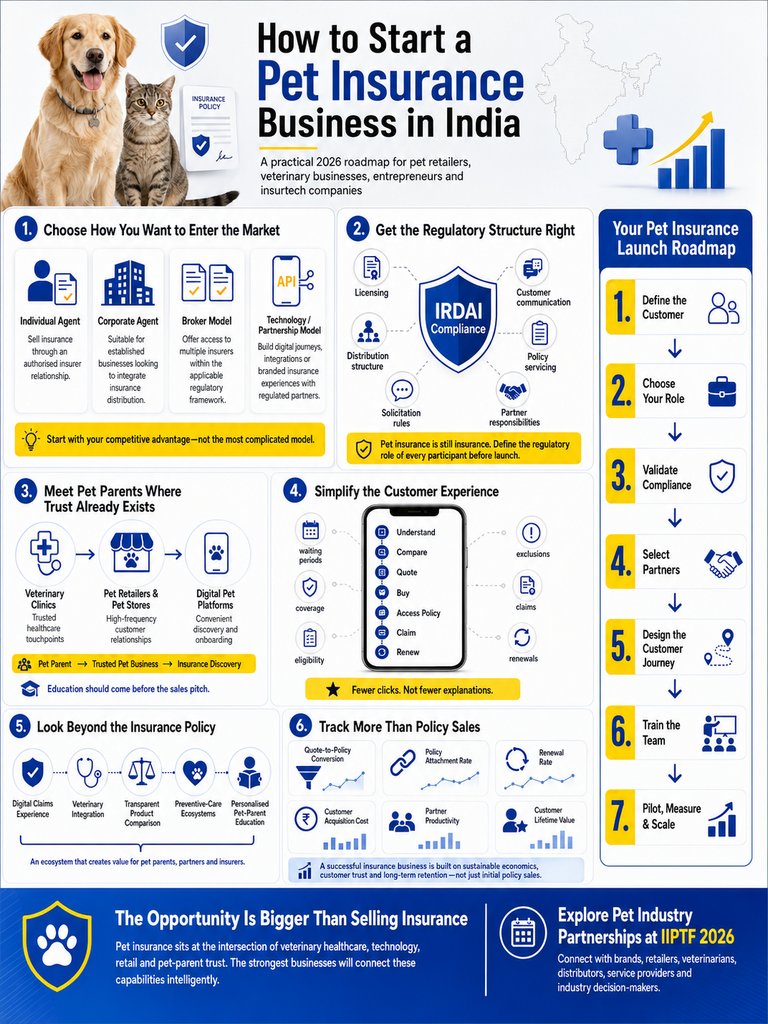
A Practical Launch Roadmap
A pet insurance venture should begin with validation rather than a large product launch.
Step 1: Define the Customer
Decide whether you are primarily serving dog parents, cat parents, breeders, veterinary customers, premium urban pet parents or another clearly defined audience.
Step 2: Choose Your Role
Determine whether your advantage lies in regulated distribution, referrals, technology, veterinary integration, customer acquisition or branded partnerships.
Step 3: Validate the Regulatory Structure
Map every customer-facing activity and establish which entity is legally responsible for solicitation, advice, policy issuance, underwriting, payment and servicing.
Step 4: Select Partners
Compare insurers, licensed intermediaries, technology providers and veterinary partners based on both commercial terms and customer experience.
Step 5: Design the Customer Journey
Make it easy for someone to move from:
Awareness → Understanding → Quote → Purchase → Policy Access → Claim → Renewal
Every unnecessary step creates potential drop-off.
Step 6: Train Frontline Teams
Anyone discussing insurance with pet parents needs clear boundaries regarding what they can explain, what they cannot promise, and where customers should go for regulated advice or policy-specific questions.
Step 7: Pilot Before Scaling
Test the proposition with a limited customer group, location or partner network.
Learn which questions customers ask, where they abandon the process and which messages create trust.
Then scale what works.
Is Starting a Pet Insurance Business in India Worth Exploring?
Potentially, yes—but the strongest opportunity may not belong to the company that launches fastest.
It may belong to the business that understands the ecosystem best.
Pet insurance sits at the intersection of financial services, veterinary healthcare, technology, retail and pet-parent trust.
That makes it more complex than launching another pet product.
It also makes it strategically interesting.
A pet retailer may bring distribution.
A veterinarian may bring trust and healthcare context.
An insurer brings underwriting capability and regulatory infrastructure.
An insurtech business may bring technology.
A strong pet insurance proposition can emerge when those capabilities work together rather than when one participant tries to do everything alone.
Pet Insurance Businesses to Watch in India
Businesses researching the market should study currently available products rather than relying solely on market reports.
Examples include HDFC ERGO Paws n Claws, current pet-insurance offerings from Bajaj Allianz, and Digit Pet Insurance. Their products illustrate how coverage structures, eligible pets, benefits and policy conditions can vary across the market.
Understanding these differences is valuable not only for competitors, but also for retailers, veterinarians and entrepreneurs evaluating possible insurance partnerships.
Frequently Asked Questions
Can I start a pet insurance business in India?
Yes, businesses can participate in the pet insurance ecosystem, but the structure matters. Activities involving insurance solicitation, distribution, broking or underwriting may be regulated and should be established within the applicable IRDAI framework.
Do I need an IRDAI licence to sell pet insurance?
The requirements depend on your role. IRDAI regulates insurance agents, corporate agents, brokers and other insurance-distribution structures. If your business intends to solicit, advise on or distribute insurance, determine the appropriate regulatory route before launch.
Can a pet shop offer pet insurance to customers?
A pet shop may potentially participate through an appropriately structured partnership or regulated distribution arrangement. Simply operating a pet shop does not automatically authorize the business to sell insurance.
Can veterinary clinics sell pet insurance?
Veterinary clinics can explore partnerships within the insurance ecosystem, but the ability to solicit or sell insurance depends on the regulatory structure used. Clinics considering direct distribution should obtain professional guidance regarding the applicable IRDAI requirements.
What is a white-label pet insurance business?
In commercial terms, a white-label model generally involves presenting an insurance proposition through another brand or customer experience while a regulated insurer provides the underlying insurance. The exact distribution, branding and regulatory responsibilities must be clearly structured between the parties.
Which companies currently offer pet insurance in India?
Current examples include HDFC ERGO, Bajaj Allianz and Digit. Product availability, terms, coverage and eligibility can change, so businesses and customers should check current insurer documentation before making decisions.
Can pet insurance cover cats as well as dogs?
Some Indian products do. For example, HDFC ERGO currently markets coverage for dogs and cats, while Bajaj Allianz also provides cat-insurance information in addition to dog insurance. Coverage varies by insurer and product.
Are pre-existing conditions covered?
Coverage of pre-existing conditions depends on the policy wording and insurer. Businesses should avoid making broad promises and should direct customers to the specific policy schedule, exclusions and insurer documentation.
How can pet businesses make money from pet insurance?
Potential economics depend on the approved distribution or partnership model. Revenue arrangements, commissions and remuneration should be assessed based on the applicable regulatory framework and individual insurer or intermediary agreement rather than assuming a standard industry rate.
Building the Next Pet Insurance Opportunity
Pet insurance in India should not be approached simply as another product to sell.
The larger opportunity is to build an ecosystem where pet parents can understand protection more easily, discover it at relevant moments and receive a smoother experience when they actually need to use it.
For businesses already connected to India’s pet community, that creates possibilities across distribution, veterinary partnerships, technology, education and customer experience.
The companies that succeed will likely be those that combine commercial innovation with regulatory discipline and genuine customer trust.
Explore Pet Insurance Partnerships and Opportunities at IIPTF
The India International Pet Trade Fair (IIPTF) brings together pet brands, retailers, distributors, veterinary professionals, service providers, entrepreneurs and industry decision-makers.
For businesses exploring pet insurance, embedded services, insurtech partnerships or new pet-care business models, IIPTF can provide a valuable environment to understand the market, meet potential partners and discover where new opportunities are emerging.
The pet insurance category may still be developing—but for businesses that understand both pets and partnerships, that is precisely what makes it worth watching.
